
Bates Numbering for Public Records & FOIA — Redact-First Workflow
Redact-first sequencing, FOIA response-letter CSV indexing, and retention-ready archiving for public agencies—100% locally in your browser.
Redact-First Sequencing & FOIA Disclosure Tracking
City clerks, county counsel, school districts, and state agencies processing Freedom of Information Act (FOIA) or Public Records Act requests must produce clear, auditable disclosures while protecting exempt constituent data. LegalProofKit stamps PDFs strictly inside the agency's local browser tab with zero server uploads—review our Zero-Upload Security Architecture for agency IT procurement and allowlist verification.
1. Why Permanent Redaction Must Happen Before Bates Numbering
Numbering records before redactions are finalized is the most common cause of disclosure disputes and rework:
- Preventing Unexplained Gaps: If you Bates stamp first and later withhold three exempt personnel pages in full, the requester receives a jump from
PRR-000014toPRR-000018, inviting administrative appeals over "missing records." Remove fully withheld pages before numbering, and log withheld items separately on your statutory exemption log. - Avoiding Stamp-Under-Redaction Errors: Stamping before applying black redaction boxes can cause a redaction box near the bottom margin to cover the Bates number. Always flatten permanent redactions first, then scale legacy scanned records with 92% shrink-to-fit margins so stamps sit cleanly outside original text and redaction blocks.
- Scrubbing Internal Employee Metadata: Keep Scrub basic PDF metadata checked before export so internal clerk usernames, workstation paths, or draft titles embedded in PDF properties are not inadvertently disclosed.
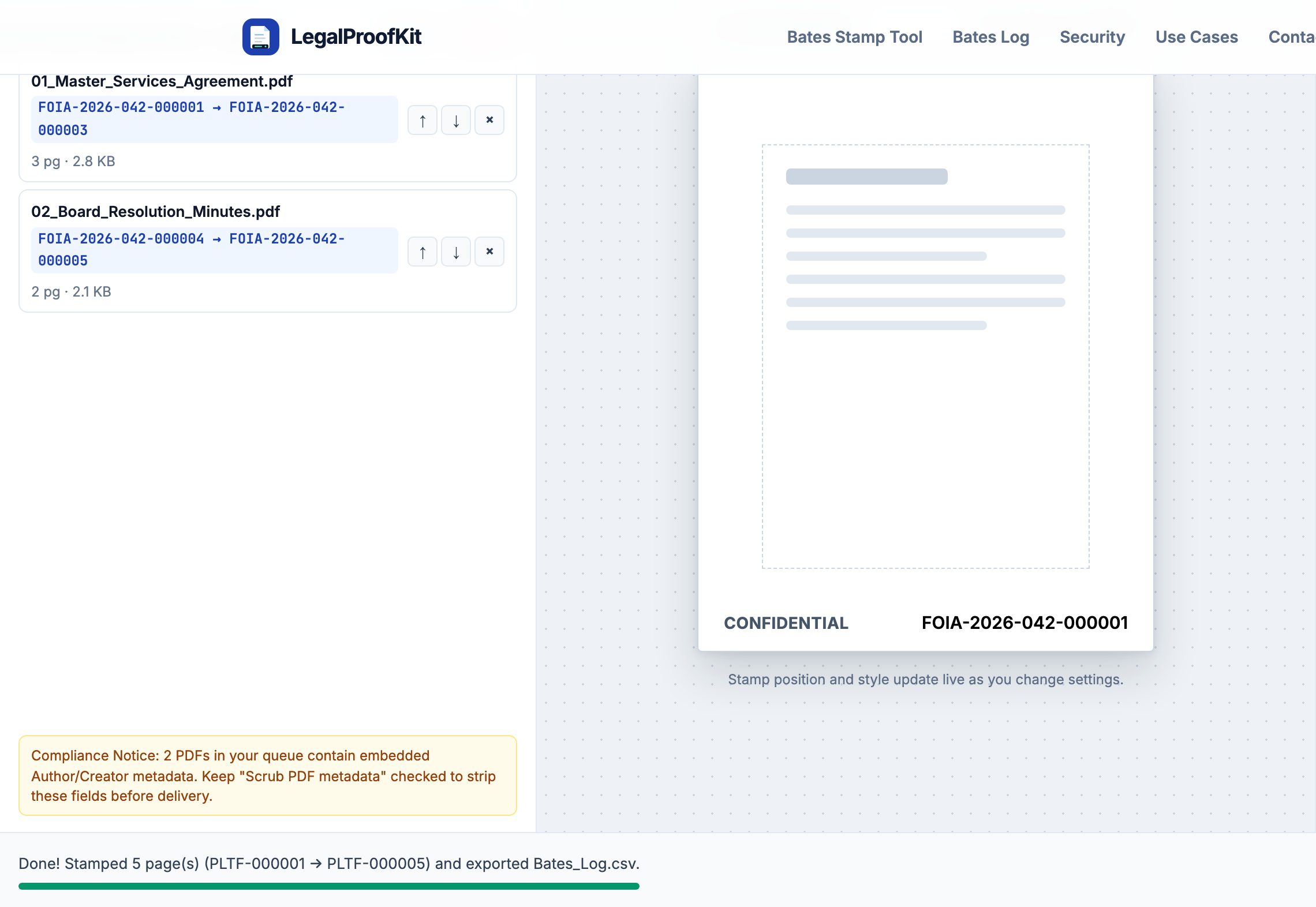
2. Attaching Bates_Log.csv to FOIA Response Letters & Retention Archives
When closing a public records request, agencies need a durable record of exactly what was released on the statutory response date:
- Request-Specific Prefixes: Use a tracking prefix that ties directly to your agency ticket ID, such as
FOIA-2026-042-orPRA-118-. - Disclosure Cover Letter Citation: Reference the exact produced range in your written response (e.g., "Responsive non-exempt records totaling 84 pages are enclosed as
FOIA-2026-042-000001throughFOIA-2026-042-000084"), and attach a cleaned copy of the exported CSV Bates log as an itemized enclosure index. - Statutory Retention Archiving: Store the ZIP archive,
Bates_Log.csv(with per-file SHA-256 hashes and UTC timestamps), andLOCAL_PROCESSING_CERTIFICATE.txtinside your agency's records-retention repository so future audits or repeat requests can prove exact disclosure integrity.
Note: LegalProofKit is a document preparation utility and does not provide legal advice or statutory exemption determinations. Follow your jurisdiction's public records statutes and retention schedules.
Frequently Asked Questions
Why must public records be redacted before Bates numbering?
Always complete and flatten permanent redactions and remove fully withheld documents before Bates numbering. Numbering only the finalized release set prevents unexplained page gaps and ensures redaction boxes never obscure Bates stamps.
How should agencies reference Bates_Log.csv in a FOIA response letter?
Cite the overall BegBates-to-EndBates span (such as FOIA-2026-042-000001 to FOIA-2026-042-000084) in your written response letter and attach Bates_Log.csv as an enclosure schedule listing each released file and page count.
What Bates prefix format works best for municipal or state FOIA requests?
Use a prefix tied to your agency's request or docket number—such as PRR-2026-042- or FOIA-0118-—with 5 or 6 zero-padded digits so future audits immediately identify which request a page belonged to.
How does Bates numbering help with public records retention compliance?
Archiving the stamped PDFs alongside Bates_Log.csv (which contains per-file SHA-256 hashes and UTC timestamps) gives records officers verifiable proof of the exact pages disclosed on the statutory response date throughout the retention period.
Ready to Bates stamp confidential PDFs locally with zero uploads?
Open the Free Bates Stamp Tool